Sunday, November 10, 2019

Life Cycle of Salmon

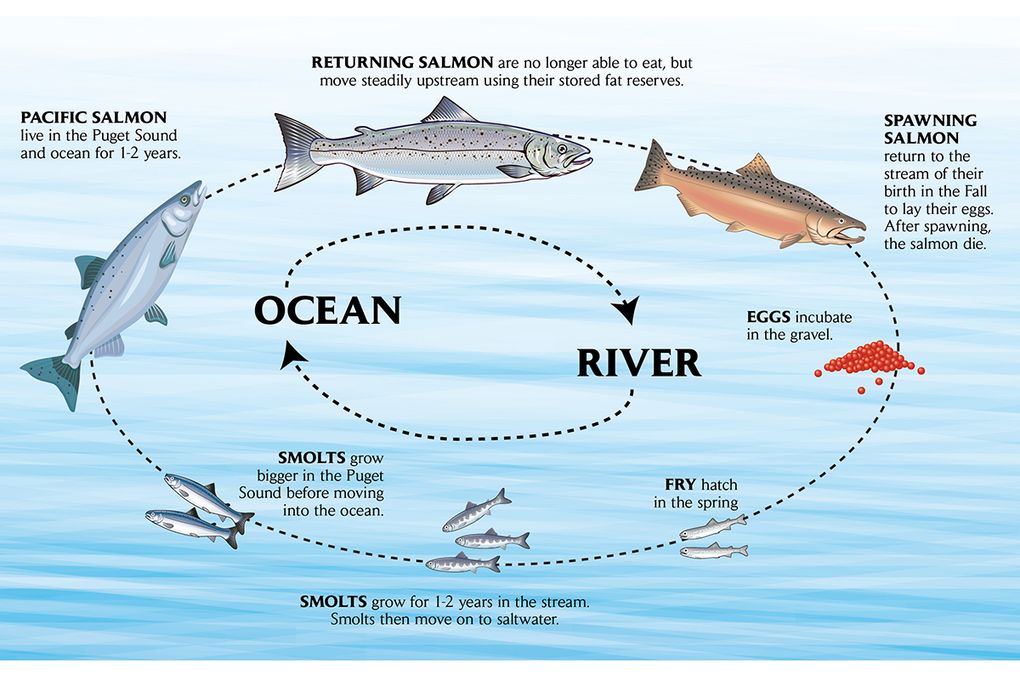
The life cycle for salmon begins in freshwater, when a redd, or female's nest of eggs is fertilized by the male salmon. These eggs remain in the gravel throughout the winter as the embryos develop. Cold, clean water is essential for healthy growth and survival of the egg. Water flowing through the gravel delivers oxygen to developing eggs. In the spring, the eggs hatch and alevins emerge. Alevins stay close to the redd for a few months. Once they have grown in size and consumed the yolk sac attached to their stomachs, they emerge from and gravel and are now considered fry. The fry swim to the surface of the water and begin to feed. The survival of fry is dependent on the quality of the stream habitat which they are in. Boulders, logs, shade, and access to side channels are important in allowing fry to hide from predators and prevent them from getting flushed downstream during floods. When the fry are one inch long, they are called fingerlings. The tiny fingerlings grow in backwaters and stream margins. As the fingerlings grow, they move to the main channel. Carried downstream by the spring thaw, salmon begin the amazing changes called smolting. Smolting is triggered mainly by the increasing daylight hours and rising water temperatures of spring. Individual territorial behavior gives way to more cooperative schooling behavior, gravel colored markings change to a silvery hue, internal changing mostly affecting the kidneys allow for the transition from fresh to saltwater. Estuaries provide a mix of fresh and saltwater habitats in which salmon smolts prepare for entering the ocean. Swimming with the tide, young salmon leave their home rivers, moving around the pacific ocean in varying migratory patterns, they live in the ocean for anywhere from 2-5 years, growing and maturing. Ocean life means escaping predators as well as avoiding fisherman. To preserve the dwelling fish runs, fishing limits are set on all takings of salmon. Researchers have found that while in the ocean, salmon often travel phenomenal distances for food. During this time, they increase in weight--often more than 100 fold. Temperature and food conditions can be highly variable from year to year. A large percentage of fish do not survive the difficult ocean passage. Eventually an instinctive trigger tells mature salmon the time has come to return to their home streams and reproduce. Triggered by an irresistible instinct to spawn, salmon find their way back to the river mouth, then head upstream with great determination. While dams block their way, many have fish ladders that allow fish to swim around the dams. The homeward bound salmon no longer eat, living off of stored fat, pausing only occasionally to rest. They endure weeks of struggle against powerful currents up hundreds of miles of river. Bruised and battered, wearing tooth marks from unsuccessful predators, they swim on to the headwaters, their health declining rapidly. Even after spawning, the cycle is not quite complete. Salmon carcasses give food to the forests, the predators, and the insects.

In 2001, the population of coho in the Russian River was down to less than 100 fish--potentially down to a population of around 10. Stream flows are elevated to around 7 times above the natural flow level on the Russian River. We can't reduce the flows because of the demand for water, but we can spread the flows to reduce the velocities. One method of doing this is creating channels for the fish where the waters will not move at such a high velocity. This creates the ideal rearing habitat for coho salmon. When there are winter floods and the flow goes up and the fish need to get out of the way of the high water, they can go into channels that are built. With small tags plants in juvenile fish, you can use antennas to detect when the fish enter the habitat features so you can know when the fish are coming and going from the habitat features. Fish stay in these habitats during high flood events for up to a week at a time.
Image result for salmon life cycle

Monday, October 21, 2019

"The Story of Bottled Water"

When you test bottled water against tap water, the water is not consistently cleaner. In many ways, bottled water is less regulated than tap water. Further, in taste tests across the country people consistently choose tap water over bottled water. Bottled water costs about 2000x as much as tap water. People in the U.S. buy more than half a billion bottles of water every week. The origin story of the water bottle explains how bottles became such a ubiquitous item in our society.

In the 1970s soft drink companies got worried when they saw their sales leveling off. In response to this, they started selling water bottles. People initially dismissed water bottles as a fad thinking the concept was ridiculous since they had access to free water. Water bottle companies then began to manufacture demand. They did this by making people scared, seducing them, and misleading them. They made ads to promote their products and dismiss tap water. They then hid the reality of their products behind fantasies of mountain streams and pristine nature. One third of all bottled water comes from tap water including Dasani and Aquafina. Nestle continued the misleading in proclaiming that bottled water is the most environmentally responsible consumer product in the world, which is a blatant lie.

Oil is used to make water bottles. Each year, making the amount of water bottles used in the U.S. takes enough oil and energy to fuel a million cars. Additional energy and oil is used to ship the bottles around the planet. Afterwards, the bottles must be disposed of. Eighty percent of all water bottles end up in landfills where they will sit for thousands of years or they are put in incinerators where they're burned releasing toxic pollution. The rest gets collected for recycling. The water bottles that are collected for recycling are often downcycled into lower quality products which will be thrown away later. The parts that can't be downcycled are thrown away.

Another aspect of the misleading, scaring and seducing of consumers that water bottle companies have undertaken is slandering the other product--tap water. These companies want us to think that tap water is dirty and that bottled water is the best alternative. The irony of this is that not only is that claim unfounded, since it has been proven that water bottles generally don't have consistently cleaner water, but in the intances where the water is polluted, making water bottles a safer alternative, water bottle companies are partially to blame for this water pollution.

If you would like to learn more, view the following video:
https://vimeo.com/10441794

Image result for plastic water bottles empty

Sunday, October 6, 2019

Soil and Symbiosis

One incredibly beneficial and all-too-often overlooked method of farming is permaculture farming. Permaculture farming involves the development of agricultural ecosystems that are intended to be sustainable and self-sufficient. One farm which abides by permaculture methods of farming is the Polyface Farm located in Swoope, Virginia. At this farm, the cows, pigs, sheep, chickens, rabbits, and turkeys have a symbiotic relationship in which they all perform ecological services for one another. To illustrate this, on the farm, three days after the cows have grazed the field, the chickens are released onto the field where they dig through the cow patties, eating the maggots, larvae, and flies, spreading the manure out, and releasing nitrogenous manure. This all allows for the enrichment of the soil. This process produces incredible yields. On only 100 acres of land, the Polyface Farm produces 40,000 lbs of beef, 30,000 lbs of pork, 25,000 dozen eggs, 20,000 broilers, 1,000 turkeys, and 1,000 rabbits worth of food. This is the product of permaculture farming. In addition to this, when the cows graze the grass, a lot of leaf mass is lost. After this, the grass, in order to keep the root mass to leaf mass ratio correct, sheds some of its roots. The species in the soil then chew through those roots and decompose them, resulting in new soil.

Keeping with the discussion of soil and sustainability, another overlooked aspect of sustainability is the importance and potential of soil as a carbon pool. Carbon rich soils act like giant sponges, absorbing water during floods and providing it to plants in times of drought. Further, adding carbon to soil makes the land much more productive. If we were to to increase soil carbon by 0.4% per year we could store 75% of global greenhouse gas emissions. Land management practices increase potential to store carbon- practices like keeping soil covered with plants, increasing crop diversity, composting, and carefully planned grazing are proven ways to put carbon back into the soil.

To learn more about the information addressed in this blog, watch the following videos:


https://www.ted.com/talks/michael_pollan_gives_a_plant_s_eye_view

Image result for soil


Sunday, September 29, 2019

Six Ways Mushrooms Can Save Our Planet

According to mycologist Paul Stamets, there are six ways the mushrooms can help save the universe:
  1. Cleaning up oil spills
  2. Absorbing farm pollution
  3. Fighting off disease
  4. Combating insects
  5. Encouraging life
  6. Creating a sustainable fuel source
If you'd like to watch the Ted Talk where Stamets thoroughly discusses this potentially universe-saving species, visit the link below!

https://www.youtube.com/watch?v=_5gUSyKTCx4

Image result for mushrooms

Monday, September 23, 2019

Overpopulation

Overpopulation is a problem in a society in which there's more of a species in an environment than that environment can sustainably support. Today, humanity is faced with a problem of overpopulation. This is primarily the result of declining death rates. In 1950, the total world population was at about 2.5 billion. Presently, the human population has reached an all-time high of about 7.5 billion. Further, our population is expected to reach 9 billion by 2050. Overpopulation introduces many complications into the world, including depletion of natural resources, accelerated habitat loss, amplified climate change and global warming, loss of biodiversity, depreciation of fresh water, diminished quality of life, the emergence of new pandemics and epidemics, intensive farming practices, as well as a rise in unemployment, crime, and violence. The capacity of earth to provide space, food, and energy are all limited; however, our population growth is growing without limit. Slowing human population growth and lowering our use of natural resources are key to reducing the impact we have on the planet.

Here are some things that you can do individually to help combat our population crisis:
  • Contact your representatives and urge them to support reproductive-health services and family planning
  • Communicate with those around you about the need for a sustainable population size
  • Support initiatives and organizations that help fight overpopulation
  • Lastly, educate yourselves!

If you'd like to start doing your part in combating overpopulation, say no more! I have a couple of links below this that I would like you to check out to increase your knowledge of the crisis of overpopulation. I hope you will do your part and spread this message to others as well!

I highly recommend you watch the video linked below for a visual representation of population growth over the past two centuries!

https://vimeo.com/130468614

If you're interested in learning more about the causes of overpopulation, some myths surrounding overpopulation, and some great ways we can work to solve this crisis, the next link is for you!

https://www.scribd.com/document/63612687/POPULATION-The-Multiplier-of-Everything-Else-by-William-Ryerson

Image result for overpopulation

Monday, September 16, 2019

Crash Course on Carbon

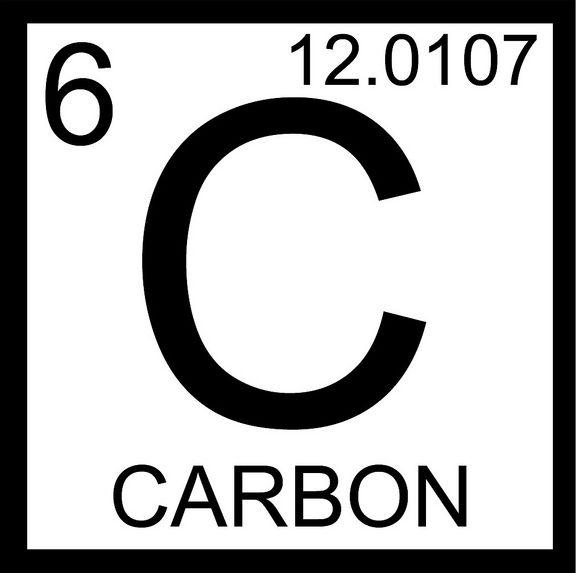
The carbon cycle is a series of exchanges where carbon moves between the atmosphere, vegetation, soil, ocean, and fossil fuels. Carbon is essential to build the organic molecules that characterize living organisms. The main source of carbon for producers is CO2 from atmospheric air, which is also dissolved in lakes and oceans. Though, our atmosphere only contains 1% of the earth's total carbon pool; most of the carbon on earth is located in the ocean. There is also carbon in carbonate rocks (limestone, coral) and in fossil fuels (mineral coal and petroleum).

During photosynthesis, green plants take CO2 from the abiotic environment and incorporate carbon into the carbohydrates they synthesize. Part of these carbohydrates is metabolized by the same producers in their breathing, returning carbon to the surrounding environment in the form of CO2. Another part of these carbohydrates is transferred to animals and other heterotrophs, which also release CO2 when breathing. The complete carbon cycle requires that decomposers metabolize the organic compounds of dead organisms and add new amounts of CO2 to the environment. CO2 is also added to the atmosphere as a result of volcanic activity, the erosion of carbonate rocks and, above all, the burning of fossil fuels by man.

All of this is important to understand because CO2 is a major greenhouse gas which causes heat to be retained between the earth and the atmosphere.

The excessive industrial activity that has been registered in the world since the Industrial Revolution is the main cause of global warming. The vast majority of processes developed since the Industrial Revolution release a huge amount of greenhouse gases that, once in the atmosphere, deteriorate the ozone layer and, at the same time, expose the Earth directly to the sun's rays.

Carbon dioxide or CO2 is the best-known gas of all because it is primarily responsible for preventing heat from escaping into the lower layers of the atmosphere; its production has increased by about 6 billion metric tons a year since 1990.

According to Alice Bows in the Ted Talk linked at the bottom of this post, in order to avoid a 4-degree climate increases, we need to cut down our carbon budget significantly. If we fail to do so, we will find that our infrastructure has not been designed to cope with an increase of 4 degrees. Further, we will be forced into a devastating food crisis as yields of maize and wheat in many parts of the world would be 40% lower than they are today and rice would have a 30% lower yield.

There are many ways that you can do your part in cutting down our carbon output! Here are some ways you can reduce your carbon footprint:
  • Give up (or eat less) meat
  • Unplug your devices
  • Don’t leave lights on when you don’t need them
    • Also, try and use natural lighting when you can!
  • Ride your bike, walk, or use public transportation whenever possible
  • Give up fast-fashion retailers such as Forever 21, Zara, and H&M
  • Shop at second-hand clothing stores such as Goodwill
  • Eat locally
  • Air dry your clothes rather than using a dryer
  • Use cold water in your washing machine
  • Buy less stuff
  • Bring reusable bags when shopping
  • Switch from incandescent light bulbs to LED
I recently calculated my annual carbon footprint using https://www.carbonfootprint.com/
Calculator.aspx and discovered that I am responsible for the output of 4.67 metric tons of CO2e per year. I plan to cut down my carbon footprint by making sure I don’t have lights on in my house when they are not needed and cutting back on my use of a dryer.

If you would like to watch the Ted Talk referenced earlier, follow this link:
https://www.ted.com/talks/alice_bows_larkin_we_re_too_late_to_prevent_climate_change_here_s_how_we_adapt/discussion

If you’re interested in learning more about the carbon cycle, check out this video:
https://www.youtube.com/watch?v=nzImo8kSXiU

Related image

Sunday, September 8, 2019

What Does it Mean to Shop Locally?

In the study linked at the end of this post, you can learn how buying from local businesses such as Sonoma County’s Oliver's benefits the local economy far more than non-local businesses. Going local is when merchants and consumers purchase locally instead of giving into the price incentives of sourcing goods globally. One challenge with buying locally is the difficulty to define what is considered local. A second challenge is leakages and when outside vendors entice local consumers to purchase their goods. A "leakage" takes place whenever someone makes the choice to buy something that is not local. An example of a leakage could be if a local grocery store pays an employee who then goes to a non-local restaurant to spend their money. Even when going local, there may be reasons to outsource from other areas that have a comparative advantage in a certain area.

A common concept addressed when discussing going local is the multiplier effect. The multiplier effect claims that the existence/expansion of an industry has a ripple effect on local/global economies. IMPLAN is used to analyze the employment, revenue, wage, and tax effects of economic events. There are three impact classifications: direct, indirect, and induced. If you add these three impact classifications up, you can measure the total effect that an industry has on an economy. Direct effects are event-specific. An example would be the construction of new facilities and subsequent hiring of local workers, which has a direct effect on the local employment, tax, and business revenues. Indirect effects stem from the new workers and businesses who use their new income and spend a portion of their money on other businesses' goods and services. This revenue flow results in higher employment, wages, revenue, and taxes. Induced effects are similar to indirect effects, but come from indirectly affected workers and firms and the economic gains they get from the indirect effects. When a local grocer buys goods from a local supplier, hires local workers, and keeps their profits local by reinvesting in the community, the multiplier effect is more robust than other retailers who focus outside the local arena.

A locally-based economy differs from one with more “foreign” purchases in a number of ways! When you buy locally, you support yourself and others in your community. When you buy from an independent, locally owned business, rather than a nationally owned business, significantly more of your money is used to make purchases from other local businesses, which helps support the local economy as a whole. Further, local businesses hire significantly more local residents, which adds value to the local economy. In addition, local businesses reinvest in their communities. Because they’re owned by people in the community, these businesses are less likely to leave and more invested in the future prosperity of the community. Grocers that are not headquartered locally send revenue to other areas outside of where you purchase them. However, if a business is local, the grocery store retains and circulates its profits locally, contributing to the multiplier effect. For every $100 spent at Oliver’s on local goods versus buying the same goods at a national or regional chain, there is at least 11.5 percent larger economic impact on Sonoma County. Shopping locally reduces your environmental impact. By staying local instead of driving to the next town’s grocery story or ordering an item from across the country, you can help reduce gas emissions and environmental damage. Additionally, since local businesses tend to purchase from other local businesses, supporting them helps minimize the environmental impact of transporting out-of-town goods. Further, tax revenues are generated from taxable sales and purchases. For every $100 sold of local goods, the local store generates about $20.4 through state and local taxes while a non-local store only generates $7.51 for that same $20.4.

Oliver’s has had an incredibly positive effect on Sonoma County. Oliver’s current operations provide over $184.3 million, $19.3 million in state and local taxes, and create or sustain over 711.5 jobs for Sonoma County. If a non-local grocer hires and buys locally in the same capacity, Sonoma County loses over $6.5 million of the broader impacts because the profits go away from Sonoma County. If the non-local grocer does not source goods locally, Sonoma County loses over $57.6 million annually. Oliver’s local buying protocols are a simple but powerful example of what it means to go local. Oliver’s may have as much as a 155 percent more impact when local residents shop at Oliver’s versus another, non-local retailer, and even more in local tax retention.

For more information on the benefits of shopping locally and a thorough case example with Oliver's market, click the link below!

Sonoma State University - Study: Going Local as a Retailer

Image result for oliver's market